Our Thinking
From Reaction to Resilience: How Utilities Are Reinventing Wildfire Strategy
 Jordan Morse
Jordan Morse
Jordan Morse
Wildfires are no longer just a seasonal threat to utilities and the communities they serve. Increasingly erratic weather driven by climate change now stresses infrastructure all year. Long-term warming and prolonged drought keep landscapes dry longer, heightening the risk of ignition from vegetation and debris. At the same time, expanding utility service territories push infrastructure into high-risk areas, often before maintenance programs, vegetation management, and safety measures are fully established.
Wildfires are no longer seasonal — they’re a year-round reality. For utilities, that changes everything. The old playbook of reacting after ignition is no longer enough. Effective mitigation now hinges on building resilience in advance through proactive strategies, advanced technology, and a culture that puts safety first.
Here are my eight key takeaways from the 2025 Red Sky Summit on how utilities are reshaping their approach to wildfire risk, and what it means for our industry.
Utilities are redefining their mission. Safety now outweighs continuity. Instead of prioritizing continuous grid energization above all else, companies are implementing proactive measures to prevent catastrophic events. This includes halting operations when conditions pose unacceptable risks and embedding safety protocols into every layer of decision-making. From leadership mandates to frontline empowerment, utilities are integrating safety metrics into performance evaluations and leveraging immersive training to prepare crews for critical moments. The guiding principle is clear: if the environment isn’t safe, operations pause.
While prevention remains the goal, utilities know ignitions can still happen under specific circumstances. That’s why utilities are improving their response capabilities significantly. From PG&E’s HAWC centers and multi-sensor fusion to space-based FireSat detection, the speed and precision of the intel-to-action loop are unmatched compared to just a few years ago. Modern control centers now integrate satellite imagery, drones, and AI-driven fire spread models, allowing utilities to work with emergency responders in near real-time. Hours of uncertainty turn into minutes of decisive action.
The same AI and machine learning models, weather analytics, and grid telemetry support both prevention and response. Utilities are building advanced “where” (3D risk mapping) and “when” (time and weather forecasting) models to anticipate and stop problems before they start. These are more than just technological advances; they’re strategic advantages. Breaking down silos between planning and operations means resources can be deployed dynamically, vegetation management can be prioritized, and work practices can adapt to changing conditions. The result is fewer ignitions and faster containment when they occur.
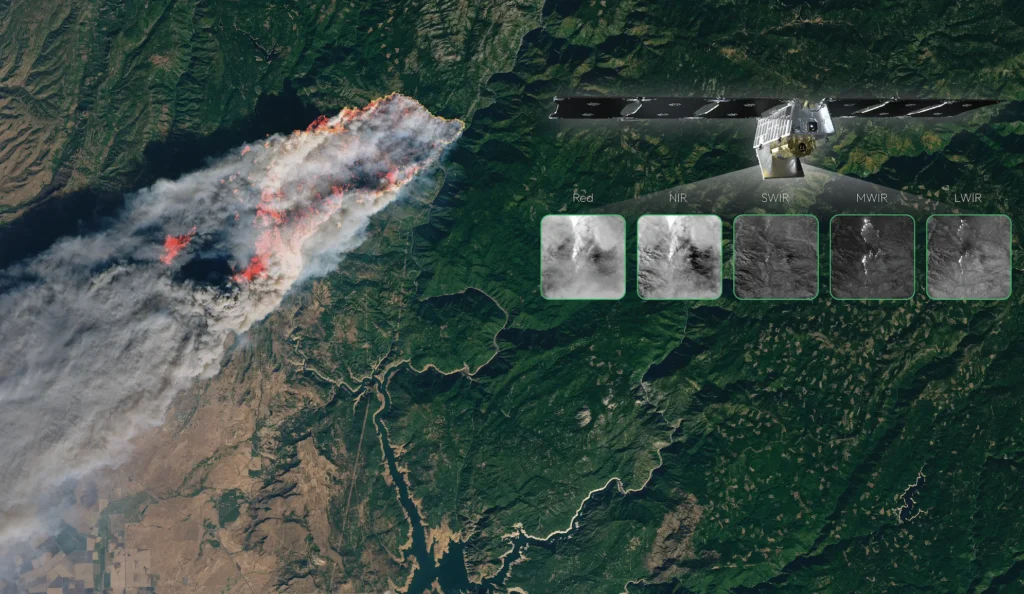
FireSat, developed with Google Research, Muon Space, and others, can spot wildfires as small as a classroom (5×5 meters) in just 20 minutes. Photo: ESG News.
Public Safety Power Shutoffs (PSPS) are no longer blunt instruments. Across the industry, utilities are now utilizing PSPS as precision tools — leveraging granular weather data, predictive modeling, and advanced analytics to make highly targeted decisions. Hyper-local risk models and real-time dashboards allow operators to pinpoint the smallest areas of concern, reducing unnecessary outages and improving transparency. This process redesign transforms PSPS from a broad, disruptive measure into a surgical safeguard that balances reliability with community safety. By refining these strategies, utilities are decreasing risk with accuracy and accountability.
Not only is PSPS becoming more surgical, it’s becoming a core competency that regulators, insurers, and ratings agencies now expect. Utilities are making significant investments in weather stations, predictive modeling, and sectionalizing equipment to reduce outage footprints and shorten durations. Advanced sectionalizing devices and microgrids allow critical facilities to remain powered even during shutoffs, ensuring essential services stay online. These improvements mitigate wildfire risk and demonstrate resilience to stakeholders who increasingly view wildfire mitigation as a measure of operational excellence. PSPS readiness is no longer optional. It’s a strategic requirement for utilities to maintain trust and compliance.
Successful wildfire mitigation requires clear and consistent risk communication. Localized wildfire intelligence proves to be far more effective than broad Red Flag Warnings. Even on days with lower fire risk, clear, proactive PSPS messaging helps build trust and maintain credibility. To do this, utilities are using multi-channel strategies like text alerts, interactive maps, and community webinars to explain why and when shutoffs happen. Transparency regarding thresholds and decision-making criteria is essential. In today’s environment, data integrity and transparency create the foundation of trust.
Wildfire mitigation is a challenge too great for any single organization to tackle alone. Firefighters, utilities, tech innovators, philanthropies, and policymakers are finally working together. Bipartisan initiatives like Fix Our Forests, the Tahoe Fund in Incline Village near my home in Reno, and other initiatives are driving reform, accelerating testbeds, and expanding prescribed fire programs—a proven tool for reducing risk. Utilities are also partnering with research institutions to pilot AI-driven vegetation management and predictive fire modeling, moving innovation from concept to field deployment faster than ever.
Leveraging grid monitoring, machine learning, and automation can strengthen wildfire mitigation strategies while simultaneously boosting reliability and efficiency. Smart sensors, automated switches, and predictive analytics build a layered defense system that reduces outage times and optimizes maintenance schedules. These investments make a strong case for risk-spend efficiency, turning resilience into a business imperative rather than a compliance checkbox. This transforms technology into a powerful strategic enabler.
Building wildfire resilience isn’t a destination. It’s an ongoing journey that requires constant innovation, collaboration, and cultural change across the industry. Utilities that combine advanced technology, prioritize strong safety practices, and build collaborative partnerships will lead the way in protecting communities and critical infrastructure.
The challenges are immense. Climate volatility, aging infrastructure, and rising customer expectations demand more than incremental improvements—they call for a new standard of operational excellence. Resilience isn’t optional; it’s the bedrock of trust, reliability, and progress in an industry that is ever changing. As utilities move from reacting to anticipating, one principle remains clear: safety and reliability aren’t competing priorities. They’re inseparable, and the future belongs to those who deliver both.